
the short version
These are the need to know basics of knife care. It’s not as difficult or high stakes as knife nerds make it out to be. All you need to know is to use common sense when using your knife: be careful, they’re SHARP, use a wooden cutting board, don’t cut silly things like bones or frozen stuff, always hand wash your knife and dry with a cloth, take it to a good professional sharpener when it gets dull or needs a repair. That’s really about it. You got this, you’re going to do great!
Also, don’t throw away your knives (even cheap amazon knives)! Knives are very repairable and are always worth fixing.
Recommended Sharpeners (and Knife Repairmen):
Me: send me an email at sam@reedhammerandneedle.com to arrange sharpening.
The Epicurean Edge in Seattle. Sharpening also available by mail.
Sea Rose Knifeworks also in Seattle.
If you want to really get into the weeds with me keep reading; it’s fun in here!
Knives Are Tools For Cutting Food
I consider durability in every design decision I make. Once I ship the knife to my client, the durability also depends on them. My knives are designed to cut food extremely well and retain a sharp edge for exceptional periods of use. I make them with harder steels and much thinner geometry than factory knives. That’s how I get them to cut well and be SHARP. But it also means they can be damaged if used incorrectly. Using them for tasks other than cutting, such as twisting food apart, prying, crushing things with the flat of the blade, cutting frozen foods, bone or shell may chip or crack the blade potentially beyond repair (though more than you think can be repaired, see the repairs section below).
Edge Maintenance & Sharpening
Using a sharp blade is much safer than using a dull blade and is much better for your knife. Cutting on stone, glass, or engineered stone will dull your knife in one cut. Same goes for titanium (seriously who thought a titanium cutting board was a good idea?). I recommend natural cutting surfaces. Endgrain cutting boards are arguably the best available, but I also really like hinoki cypress wood boards and maple is a classic for a good reason. Really any natural wood is better than synthetic, stone, or titanium (again, who thought that was a good idea?). Bamboo is much better than stone or metal, but avoid it if possible. Bamboo ‘wood’ actually a type of grass and contains silicates that abrade your edge like sandpaper when you’re cutting so it’s better than stone, but it will dull your edge quicker than true wood boards.
Always protect the edge while your knife is in storage. Storing knives loose in a drawer will dull them quickly and potentially cause the edge to chip. I prefer magnetic boards, but blade slips and saya work great as well. I can make custom poplar saya for your blades, please ask at time of purchase.
Never put your knife in the dishwasher. The heat combined with prolonged water exposure can crack the handle, while detergents often contain abrasives that will immediately dull the edge. Plus a warm moist environment is the perfect way to form rust - even on stainless knives. Remember, dishwashers eat knives for breakfast. Or lunch or dinner.
Knives should be honed often. Honing re-directs any rolled edge back to true and helps maintain the cutting edge for much longer than it would otherwise last. I recommend a fine ceramic honing rod. Steel rods are largely ineffective for my knives, and diamond rods will damage the edge. My blades should be honed at 8-10 degrees per side to match the sharpening angle. In commercial kitchens your knife should be honed every 2-3 hours. At home, honing before meal prep is ideal. Leather strops are also effective for repairing your edge.
Even the longest lasting edge will eventually need to be repaired. Sharpening grinds away the old edge and replaces it with fresh steel in the correct geometry. I recommend hiring a good professional sharpener, ideally one that uses waterstones. Be cautious though, there are a lot of poor ‘professional’ sharpeners out there. In Seattle I recommend the Epicurean Edge (also available by mail) and Sea Rose Knifeworks. If you’d like to return your knife to me for sharpening, please email me at sam@reedhammerandneedle.com for details. If you’d like to sharpen at home, I recommend practicing on cheap knives until you’ve got the technique down, then transitioning to my knives. Check out the Epicurean Edge for sharpening classes and for all your waterstone and knife holding jig needs.
Caring for Carbon Steel
High-carbon steel will oxidize and patina with use and requires different care from stainless knives. It’s part of the appeal of carbon steel. It grows and changes with you as you cook with it. Always wash your knife by hand - never put your knife in the dishwasher. Again, dishwashers eat knives. Washing your knife in the dishwasher will destroy it. After handwashing, dry it with a cloth rather than letting it air dry. Air drying will result in rust. If your blade does rust, use ultrafine steel wool (type 0000) or Flitz to remove rust. These won’t remove your patina, but it will remove the active red rust and stop the corrosion. Lightly coating the blade and handle with camellia oil after washing helps promote a healthy patina. Mineral oil can also help, but I’ve found the camellia oil more effective. Coat the handle with mineral oil, camellia oil or Axe Wax every three months to best preserve the material.
Please note commercial kitchen sanitizer (or any O2 based sanitizer) will rust carbon steel blades very very quickly. Don’t let your blade sit with sanitizer on it’s surface for any longer than necessary. The same goes for citrus oil based dish soaps. I know that sounds crazy but I’ve seen it eat through stainless steel.
Caring for Stainless Steel
Always wash your knife by hand as washing your knife in the dishwasher will destroy it. I can’t say it enough - dishwashers eat knives. Literally. Practice regular edge maintenance as outlined above. Coat the handle with mineral oil, camellia oil or Axe Wax every three months to best preserve the material. Stainless steel is not impervious to corrosion, it simply stains less. Soaking the knife, or using citrus oil based soaps can cause pitting to develop.
Knife repair
Knives are tools. Sometimes tools are damaged during use and need to be repaired. I will always repair my work. Please reach out to me at sam@reedhammerandneedle.com to arrange your repair. Usually the first repair is free and subsequent repairs have a minor cost. Knives (yes even shitty amazon knives) are worth repairing. Making things out of steel is energetically and environmentally costly, and while I try to minimize the impact I have in my business, the best thing you can do is repair your current tool and keep using it. I’d love to offer repairs on knives I didn’t make, but there are only so many hours in a day. Unless I offer otherwise, take your non Sam Reed knives to the Epicurean Edge or Sea Rose Knifeworks for repair. They do accept knives for repair by mail if you’re not local.
Tips
Oh no, your tip got caught under something and bent or broke off! Super common on kitchen knives, and an easy fix. If it’s bent, I’ll try and straighten it (you’d be surprised what can be brought back to true). If it’s broken, I’ll re-profile the knife and give you a new tip to work with.
Chips
You/your partner tried to cut what with your super thin high hardness knife? It chipped out? No worries, I’ll grind the edge back, make a new edge and you’ll be back cutting easy-peasy. Excessive corrosion aka pitting in the steel can also cause chipping during normal use so beware of rust - even on stainless. Though try to avoid this - if the chips are too big your chef’s knife might have to become a utility years before its time.
straightening
Knives get bent. Probably several of your knives are currently bent slightly and you haven’t noticed. It largely doesn’t matter until the blade needs to be sharpened. It can happen during normal use, but it’ll definitely happen if you pry stuff apart with the blade. Knives are not pry bars. It’s pretty simple to straighten knives, but it should be done by someone who knows what they’re doing as you can absolutely snap a blade if it’s done incorrectly. So don’t try it at home, bring it to me, the Epicurean Edge or Sea Rose Knifeworks.
thinning
When I sharpen a knife I remove steel form the blade to create a new edge. Over time the blade gets smaller, the edge retreats from where it was when new towards the spine. This also means the blade geometry changes and becomes thicker over time. Ever wonder why your former laser of a high end Japanese knife now cuts like an old school Henckels? This is why. Your knife isn’t worn out, just needs to be re-ground! When I thin a knife, I regrind and refinish the bevels and restore the blade geometry to what it was when it was new. This is part of the normal lifecycle of a knife. If your knife now wedges when it didn’t in the past to it probably needs to be thinned.
handle replacement
Handles are the least durable part of a knife. They’re often made of wood that will warp over the time, rivets will pop, scales pull away from tangs etc. Or maybe your dog thought the handle was a good chew toy and splintered it (yes this happened). Or your guest who you love deeply accidentally put your knife through the dishwasher and the scales cracked. While this isn’t a minor repair, its simple to remove the old handle and build a new one. I’ll give you your choice of the materials I’ve got on hand and get your knife back in working order.
Don’t throw your knives away, have them repaired!
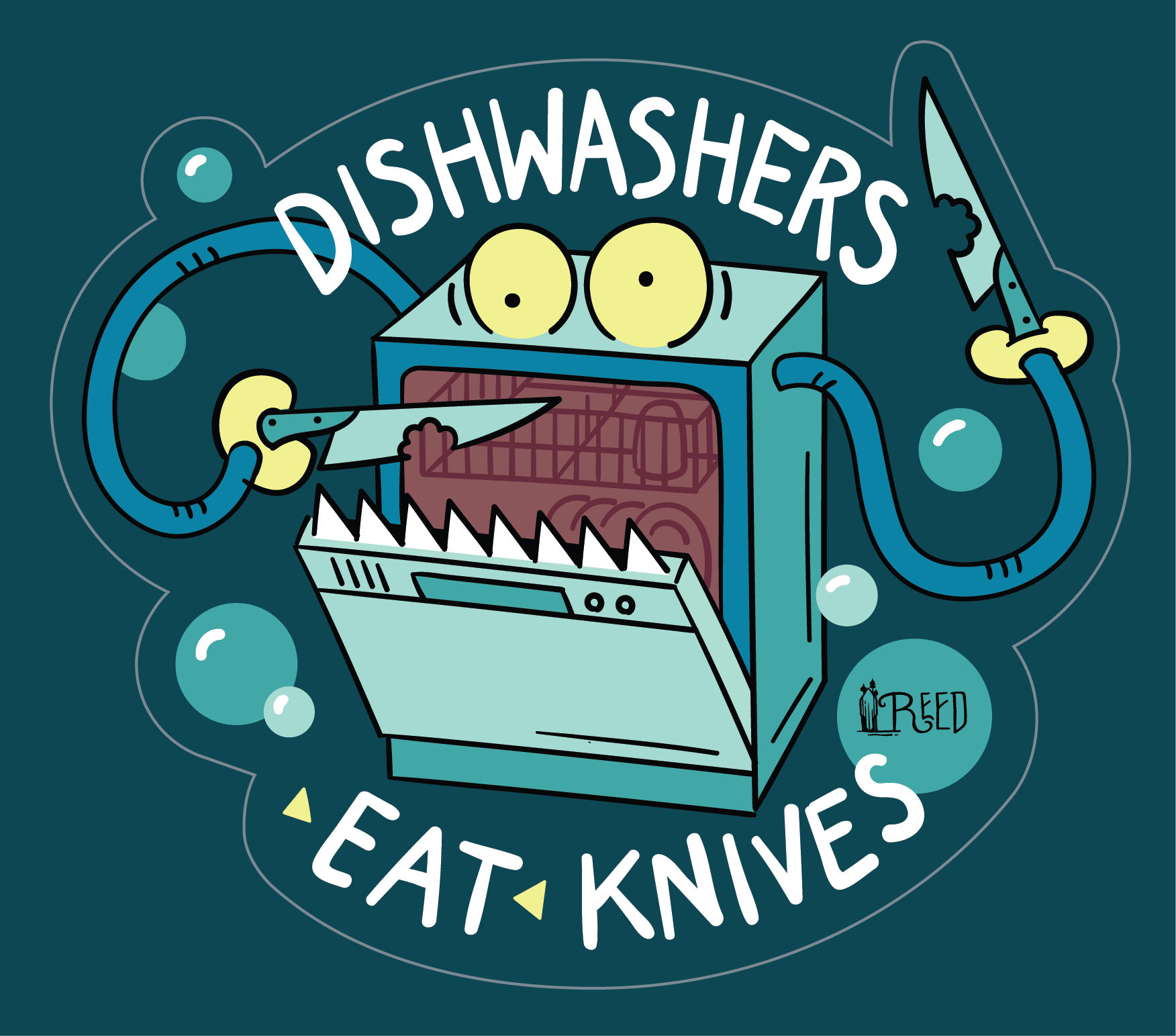
Art by Allie Tesch-Picard
