
About me
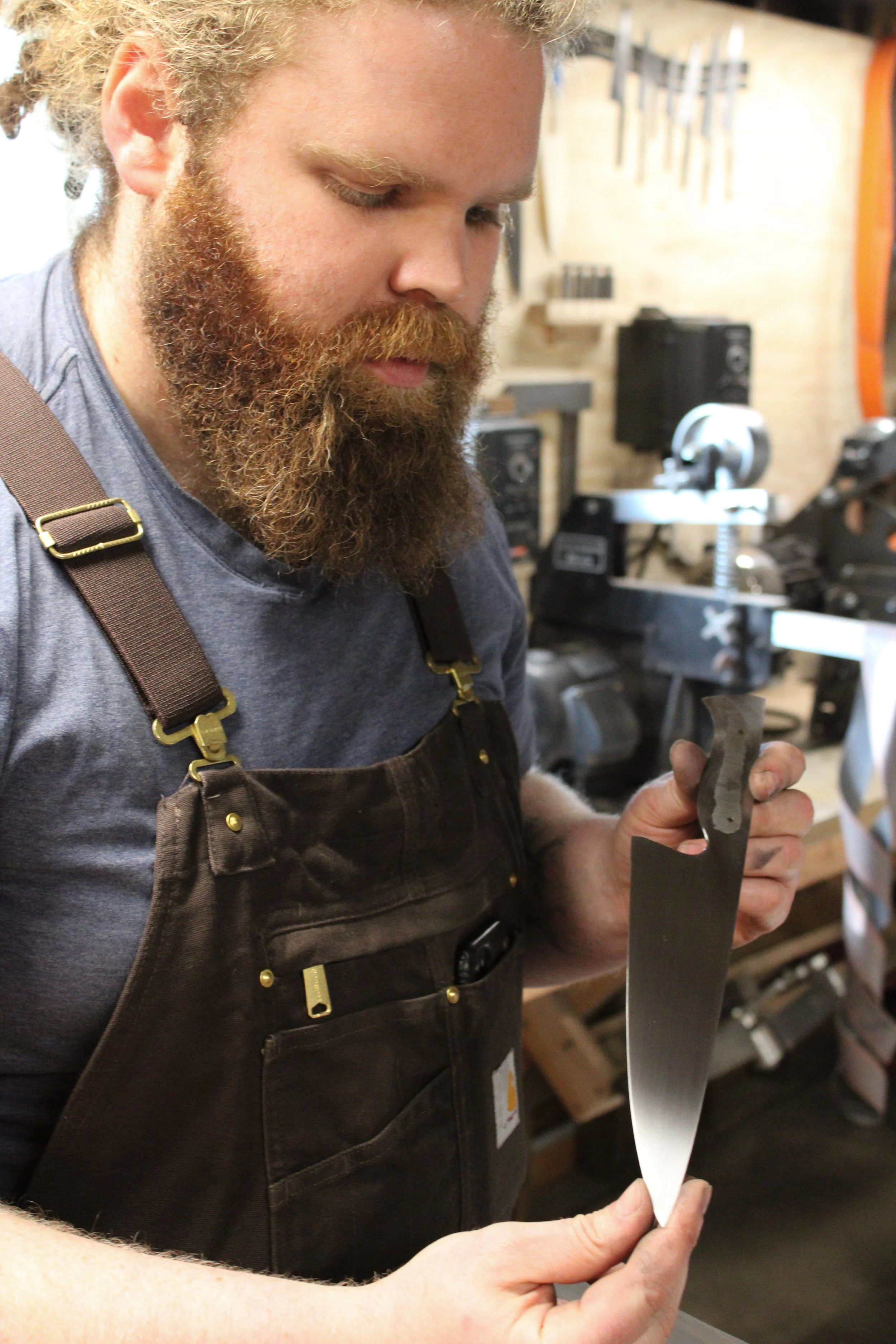
My name is Sam Reed and I am a bladesmith living and working in Seattle, WA. I first picked up bladesmithing when I wanted to cook the veggies I grew in our family garden with tools I made with my own hands. I made my first knife when I was 14 years old from a section of coil spring off an ‘90’s honda. As a knife, it’s completely useless, but I had so much fun making it I immediately wanted to make another, and another, and another.
Nothing makes me happier than to see people using good tools I made to make food for other people.
How I make Decisions when making a knife
I think about durability first and foremost in every decision I make. This goes for the knives I make, of course, but also for how I structure my business so that I can continue to be here doing the craft that I love. This also means actually taking responsibility for the impact my work has on our environment - minimizing waste during production and ensuring my knives last as long as they can. My knives are not disposable, seasonal items.
I want the knives I make to endure as long as is humanly possible.
I use the best (ideally recycled at the foundry) steels and most durable handle materials available. I design my blades with repair and restoration in mind. All my handles can be replaced. All my knives can be converted into smaller knives as they’re sharpened and reground over time. My chef’s knives are meant to serve daily for decades in their initial form, then become small utility knives and finally tiny paring knives.
I don’t make S, C, hook or other compound grinds. They look cool and perform wicked good when new, but the blade geometry often means it can’t effectively be sharpened back into useful small knives. A well designed flat, convex, or shinogi grind can.
I use as many local woods as I can, and when I do use exotics they are purchased from reputable harvesters that I know. I do stabilize most of the local woods I use with resin. To me, this is a worthwhile compromise between creating petroleum byproduct waste and making a handle that can last two decades or more. If you’d prefer your handle without resins of any kind, just ask.
I won’t use exotic animal materials or archaeological artifacts of any kind.
I will always repair/restore my work. First blade repair (tips, chips, sharpening) is free. Handle replacements and thinning aren’t free but ask about my hospitality industry discounts.
I will never use generative AI. It’s for posers.